
Connecting Deadlines, Approvals, and Compliance in Microsoft 365
For many organizations, contract risk doesn't come from the contract itself. It comes from the gaps between documents, communications, approvals, and deadlines.
Here's how a connected approach to contract management can help organizations stay in control throughout the entire contract lifecycle.
Most organizations don't have a contract storage problem. The challenge is that the information surrounding those contracts often lives somewhere else entirely.
A supplier agreement might sit in SharePoint, but related emails could be buried in Outlook, with approval discussions happening in Teams. As a result, critical information often becomes fragmented, creating numerous risks: missed deadlines, late renewals, and time wasted searching for information – rather than acting on it.
As organizations grow and contract volumes increase, these challenges become increasingly difficult to manage through manual processes alone.
Why Contract Management Becomes Difficult to Control
When organizations think about contract management, the conversation often focuses on documents.
- Where are contracts stored?
- Who has access?
- How are files organized?
These are important questions, but they only address part of the challenge.
A contract is not simply a document. It is a business process involving multiple stakeholders, approvals, communications, obligations, deadlines, and decisions. The contract file itself is only one component of a much larger picture. The real challenge arises when those elements become disconnected.
Without a structured approach, organizations often rely on personal knowledge, email chains, and manual reminders to keep contracts moving through their lifecycle. While this may work for a small number of agreements, it becomes increasingly difficult to maintain visibility and consistency at scale.
When contract information becomes fragmented, it becomes harder to understand what actions need to be taken, who is responsible for them, and when they need to happen. That’s why creating a connected contract process helps organizations maintain oversight throughout the entire lifecycle. Teams can identify upcoming milestones earlier, respond more effectively to compliance requirements, and reduce the likelihood of important obligations being overlooked.
For many organizations, one of the biggest advantages of modern contract management is familiarity. Most businesses have already invested heavily in Microsoft 365. They use Outlook for communication, Teams for collaboration, and SharePoint for document management.
The foundation is already in place. The challenge is that these activities often operate independently of one another. Contracts, communications, approvals, and deadlines become disconnected, making it difficult to maintain a complete picture of the contract lifecycle.
What Does Contract Control Look Like?
✓ Visibility. Great visibility across the contract lifecycle
✓ Awareness. Earlier awareness of renewals, renegotiations, and obligations
✓ Approvals. More consistent approval and signing processes
✓ Compliance and audits. Improved compliance and audit readiness
✓ Access. Faster access to contract-related information
✓ Time. Reduced administrative burden
✓ Overview. A single source of truth within Microsoft 365
Control isn’t about storing more documents: it’s about connecting the information around them.
From Scattered Contracts to Complete Oversight
Effective contract management goes beyond storing documents. It involves creating a clear, connected process – from contract creation through to approval, signing, management, renewal, and termination.
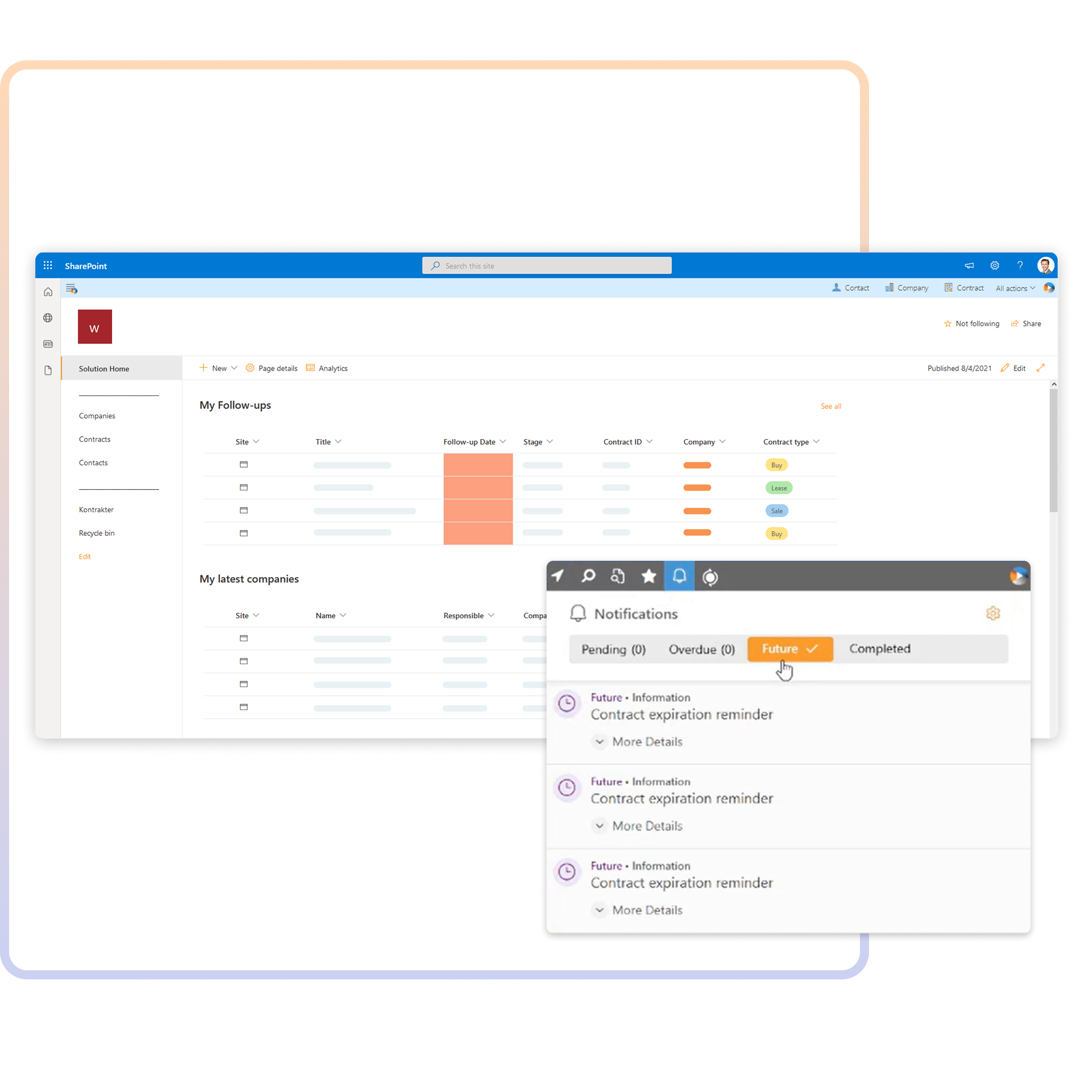
That’s why WorkPoint 365 brings contract documents, metadata, workflows, communications, and deadlines together in a single environment. Built on Microsoft 365 and SharePoint, it creates a central point of control where users can manage contract-related information: without switching between multiple systems or relying on disconnected processes.
The result is a more structured and reliable contract management process that supports both day-to-day efficiency and long-term governance.
By bringing these elements together with WorkPoint 365, organizations can create a single source of truth for contract management – without introducing another standalone platform. The result is greater visibility, stronger compliance, improved accountability, and more control over business-critical agreements.
Ultimately, contract management is not about storing contracts. It's about ensuring the right people have the right information at the right time to make the right decisions. When contracts, communications, approvals, and deadlines are connected, organizations gain the visibility they need to stay in control.
If your organization is still managing contracts across email threads, folders, spreadsheets, and disconnected systems, our most recent webinar with Konica Minolta and Simplitize, provided a practical look at how a connected approach can improve visibility and control.
The session demonstrated how WorkPoint 365 helps organizations:
- Track renewals, terminations, and renegotiations
- Standardize contract approval and signing processes
- Improve traceability and compliance
- Keep contract-related communications connected to the contract itself
- Manage contracts within Microsoft 365 and SharePoint
Learn more about WorkPoint 365 contract management right here.

To explore your options further and see the solution for yourself, book an inspirational meeting with one of our experts - no strings attached of course, and you get to choose the time that works best for you.