
The Hidden Operational Cost of Email
Email has quietly become invisible labour. But, because it happens in fragments throughout the day, most organizations barely notice.
In this article, we explore why communication itself has become one of the biggest hidden coordination – and cost – challenges inside modern businesses.
Email Has Become Business Infrastructure
According to Microsoft’s 2025 Work Trend data, the average knowledge worker now receives 121 emails every day. Not on a busy day: every day. Most organizations think they have an email problem. Too many messages. Too many notifications. Too much noise competing for attention.
However, the real issue is no longer email itself. It is everything that happens around it. The forwarding. The filing. The follow-ups. The constant switching between “real work” and the invisible administrative tasks required to keep information moving
Microsoft's own usage data from across Microsoft 365 tells a striking story. The average employee now spends 57% of their working time communicating (in meetings, email, and chat) and only 43% actually creating.
The human experience of that imbalance is equally stark: according to Microsoft. 62% of workers report that searching for information consumes more of their working day than it should, leaving too little time for the focused work that actually moves the business forward. Similarly, workers who struggle with this are 3.5 times more likely to also struggle with innovation and strategic thinking.
For many people, this is simply the job now. You open Outlook intending to move a project forward. Instead, you find yourself triaging a shared inbox, chasing context from an old email thread, locating attachments, forwarding requests, and trying to remember whether somebody already handled that customer response.
Email evolved far beyond communication a long time ago. Today, project updates arrive by email. Customer approvals happen by email. Supplier negotiations, contract amendments, compliance records, support escalations, invoices, recruitment conversations, and critical business decisions all flow through inboxes every day.
The Work Around the Work
Email management has always been central to how modern organizations operate. They consistently recognize the burden it creates. The challenge is that most businesses are still asking people to manage this burden manually.
While dealing with emails doesn’t always feel particularly onerous, throughout the working day, it can consume huge amounts of time. Five minutes here. Thirty seconds there. Another interruption. Another context switch. Another moment spent managing information rather than using it. This is the work around the work: and much of this activity creates no direct value.
“We have quietly normalized highly skilled people acting as human middleware between communication and business processes,” says Pedersen. “That is not a productivity issue. It is a design issue.”
The Inbox Has Become the Front Door of the Business
Shared inboxes expose this challenge better than anything else. These often sit at the center of important business processes, yet responsibility for managing them is usually spread across multiple people. In theory, they belong to teams. In practice, they often belong to nobody.
Messages wait because somebody assumes someone else is handling them. Requests disappear during busy periods. Teams carry the quiet mental burden of wondering whether something important has slipped through unnoticed.
This matters because email communication increasingly is the workflow. A customer email launches a support process. A permit request starts a case. A supplier update changes a delivery timeline. An invoice triggers approvals.
The inbox is no longer sitting alongside the business. For many organizations, it has become one of the main entry points into the business itself.
Governance by Discipline Doesn’t Scale
When a compliance audit demands documentation of how a contract decision was reached, "we think it was in someone's inbox" is not an acceptable answer. Governance expectations continue to rise across almost every industry. Construction companies, legal teams, auditors, energy firms, professional services organizations, and public sector bodies increasingly need not only documentation, but clear traceability showing what was communicated, when it happened, and how it was handled.
Most organizations already have governance policies designed to support this. Employees are expected to archive important communications correctly, maintain project documentation, preserve audit trails, and follow compliance procedures carefully. The problem is that governance frequently depends on individuals consistently remembering to perform manual tasks under pressure and at scale.
As communication complexity increases, maintaining governance through manual processes becomes progressively harder.
The Organizational Memory Problem
Organizational memory is another increasingly important challenge. Much of the knowledge inside modern organizations exists primarily inside communication systems rather than formal documentation structures.
Customer commitments, supplier clarifications, technical decisions, approval chains, and project context often live inside inboxes that only individual employees can easily navigate. The result is that critical business knowledge becomes siloed by default, not by design, but simply because no structure exists to make it shared. When employees move roles, leave the company, or simply cannot remember where something was stored, retrieving that information becomes time-consuming and disruptive.
Hybrid work has intensified this problem further by fragmenting communication across distributed teams and locations. Increasingly, organizations are discovering that business continuity depends less on simply storing information somewhere and more on whether communication is connected to shared organizational context in the first place.

AI Is Exposing Weak Information Structures
The rapid rise of AI tools such as Microsoft Copilot is also exposing weaknesses many organizations have ignored for years. AI systems can only work effectively when information is structured, contextualized, permission-aware, and meaningful. Disconnected inboxes, fragmented communication chains, inconsistent filing practices, and missing metadata all reduce the usefulness of AI dramatically.
This is why many organizations are beginning to realize that becoming “AI-ready” is not really about adopting AI tools alone. It is about fixing the underlying structure of information itself. The organizations that benefit most from AI are likely to be the ones with the most usable information.
The Future of Productivity Is Less Coordination
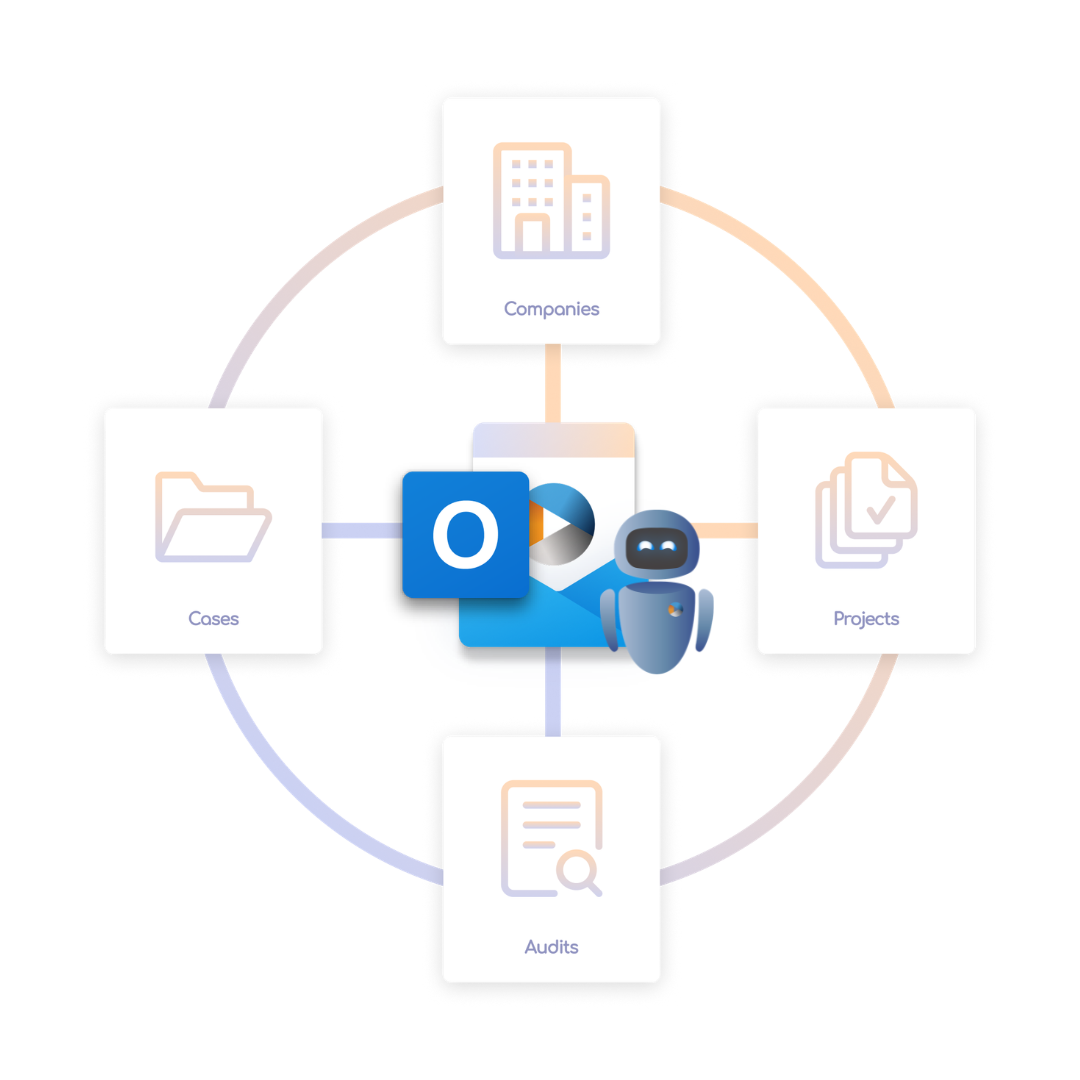
What many organizations are still missing is the layer that connects what arrives in the inbox to the business context it belongs to: the project, the case, the contract, the supplier relationship. And what needs to happen next.
That gap creates hidden operational costs: duplicated effort, fragmented records, manual filing, lost context, and time spent reconstructing information that already exists somewhere else. Most organizations have never fully measured it.
The opportunity is not replacing existing systems. It is connecting them. Monitoring inboxes is not high-value work. Refiling communications is not high-value work. Rebuilding project history from fragmented email chains is not high-value work. Yet these activities quietly consume enormous organizational energy every single day.
Ultimately, the future of productivity may depend less on helping employees work faster and more on reducing how much coordination work they are expected to perform manually in the first place.
The organizations that adapt most successfully will likely be the ones that reduce dependency on manual coordination work altogether. The real challenge facing modern businesses is no longer simply handling more communication. It is reducing the invisible burden surrounding communication itself.
Next: What Happens When Email Starts Managing Itself?
If any of this feels familiar, our next article is essential reading. We’ll explore how WorkPoint is tackling email burden directly with a new Microsoft 365-native capability designed to reduce manual coordination work, connect communication to business context automatically, and ensure important information never disappears into the cracks.
We’ll also explore how WorkPoint is addressing these challenges with a new Microsoft 365-native automation capability designed to connect communication directly to workflows, governance, and context.
See Mail Assistant in action and experience self-managing email in Microsoft 365.
